Avenue Palmerston · Brussels
Hôtel van Eetvelde: the desk found again, the history found again
- Place
- Hôtel van Eetvelde
- Architects
- Victor Horta
- Built
- From 1895
- Status
- UNESCO World Heritage
For nearly a century, the large desk of Edmond van Eetvelde was missing from the room it had been made for. Old photographs showed exactly where it stood, among the woodwork designed by Victor Horta. In 2025, the piece came back, lent by a Dutch collector.
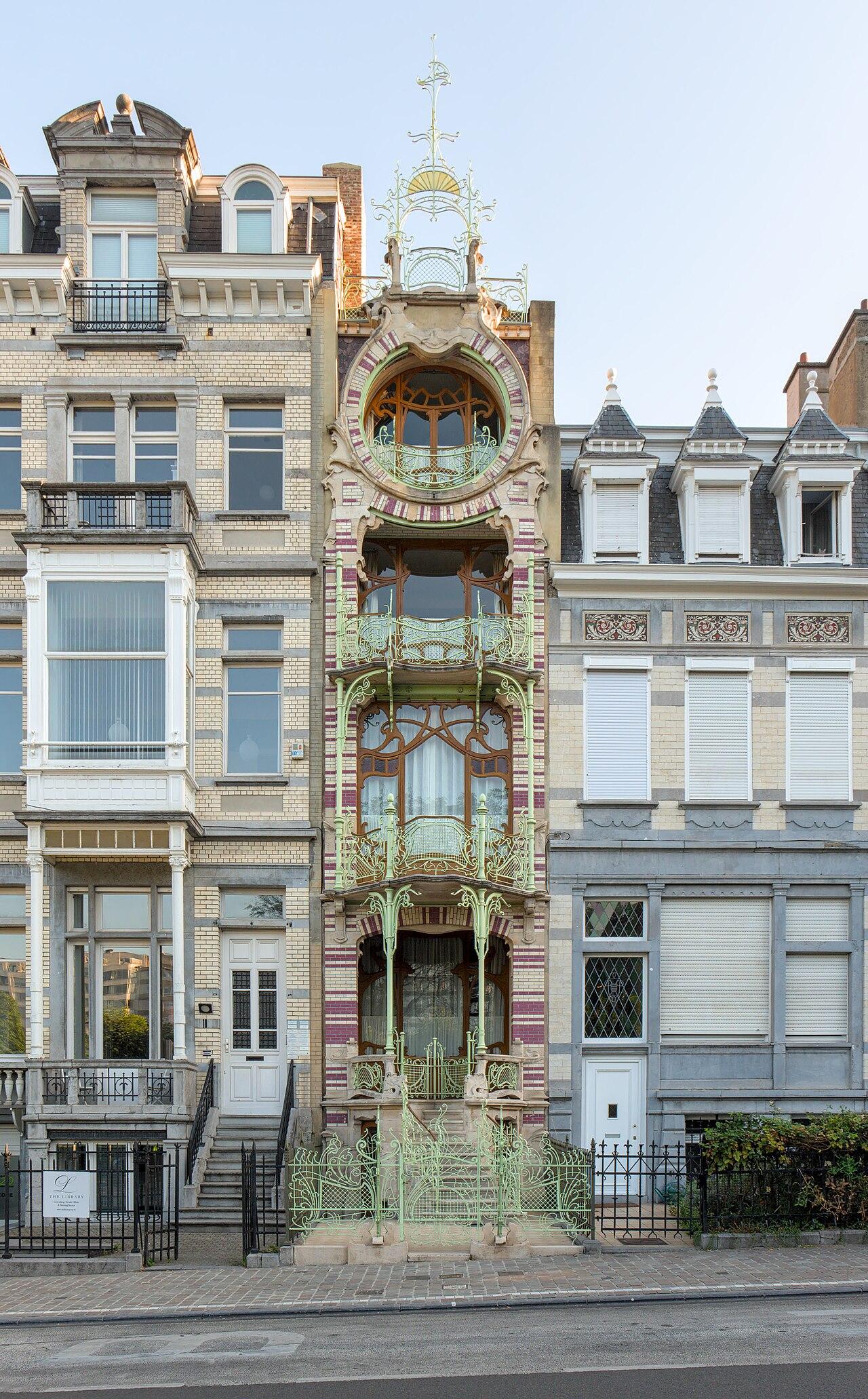
The house dates from 1895. Edmond van Eetvelde and his wife want it to hold both a family life and official receptions. On the avenue, Horta makes his intentions plain: an exposed metal frame, large panes of glass, arabesque panels between the stories.
Inside, he designs a route rather than a plan. At the heart of the house, an octagonal atrium rises two levels; the staircase and the salons are arranged around it. The glass roof opens a large corolla of clear glass edged with foliage, carried on slender metal columns. Visitors never see everything at a single glance.
This beauty had a function. Van Eetvelde was one of the principal leaders of the Congo Free State, a territory under the personal authority of Leopold II. His administration took part in a system of colonial exploitation tied to massive violence against the Congolese people. The house also served to stage this power.
The formal office was its center. Woodwork, bookcases, a marble fireplace and a large piece of furniture formed a single decor. The cabinetmaker Henri Pelseneer had made the desk to Horta’s designs; its woods and moldings echoed those of the room. A small bronze by Victor Rousseau, Le Liseur, had its place there.
In the 20th century, the house is divided and altered, and the desk disappears. It took research, collections and period photographs, checked against one another, to identify it. It is on loan for at least five years. A copy of Le Liseur, spotted at a sale in Berlin, has also returned to the room.
Inscribed on the UNESCO World Heritage list since 2000, the house now hosts visits and activities as part of LAB·AN. The same room shows a masterpiece of Art Nouveau and a witness to Belgian colonial history.
Photos : Nenea hartia (1, 2), CC BY-SA 4.0 ; Fred Romero (source), CC BY 2.0 ; FrDr (source), CC BY-SA 4.0 · Wikimedia Commons