Carrer de Cirilo Amorós 29 · Valencia
Edifici Ferrer: a father’s commission to his son
- Place
- Edifici Ferrer
- Architects
- Vicente Ferrer Pérez
- Built
- Design of 1907, built in 1908
- Status
- Local-interest heritage property (BRL)
Vicente Ferrer’s client was his father. For him, the architect designs eight apartments in a language new to Valencia, that of the Vienna Secession.
The father commissions, the son designs. The job stays in the family: eight apartments on a street corner. Ferrer merges the courtyards into one and tucks the bathrooms into the corners of the canted face.
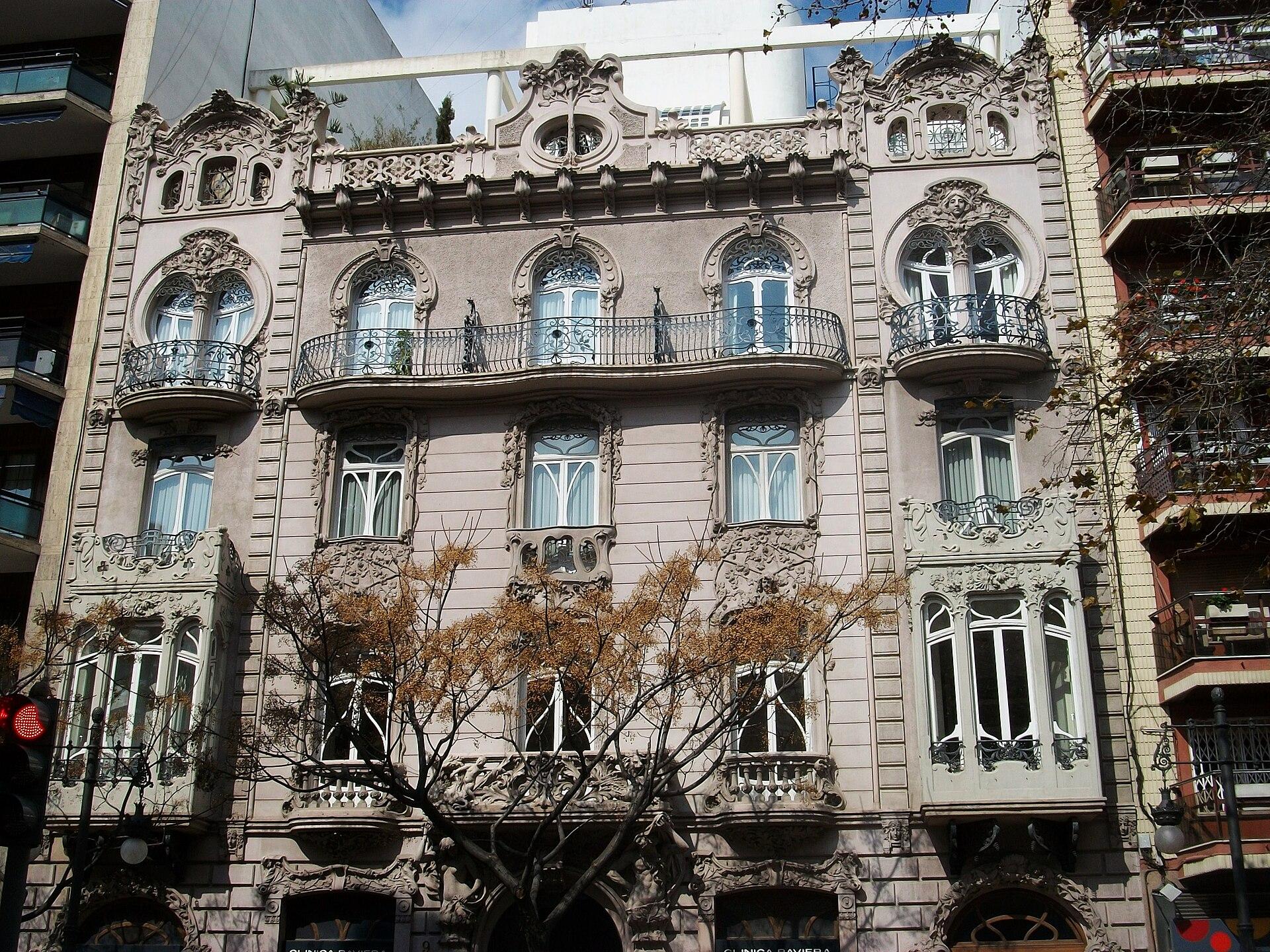
The façade breaks into three sections. Narrow recessed strips separate them, and each ends in a white gable with wavy edges. The one at the corner rises higher than the other two. A bouquet of ceramic roses crowns it, a garland of green leaves and roses hangs around a round eye, and mauve numerals give the year: 1908. The Valencia College of Architects compares these roses to Hoffmann’s palais Stoclet in Brussels.
Beneath the roses, the decoration is drawn with a compass. Large white discs are applied to the wall, and straight rods hang from them like fringe. Canopies once projected from these discs; they are gone. A checkerboard of green and white tiles runs from one window to the next. On the piano nobile, a wooden mirador juts out, with a row of round green glass panes under its cornice. The College of Architects recognizes in these discs and checkerboards the manner of D’Aronco, shown in Turin in 1902.
Three ceramic panels each bear a face. It is the same one three times: a woman in a red headdress, blond curls around her cheeks, beneath broad green leaves from which clusters of berries fall. The background is lilac. None of our sources names their author.
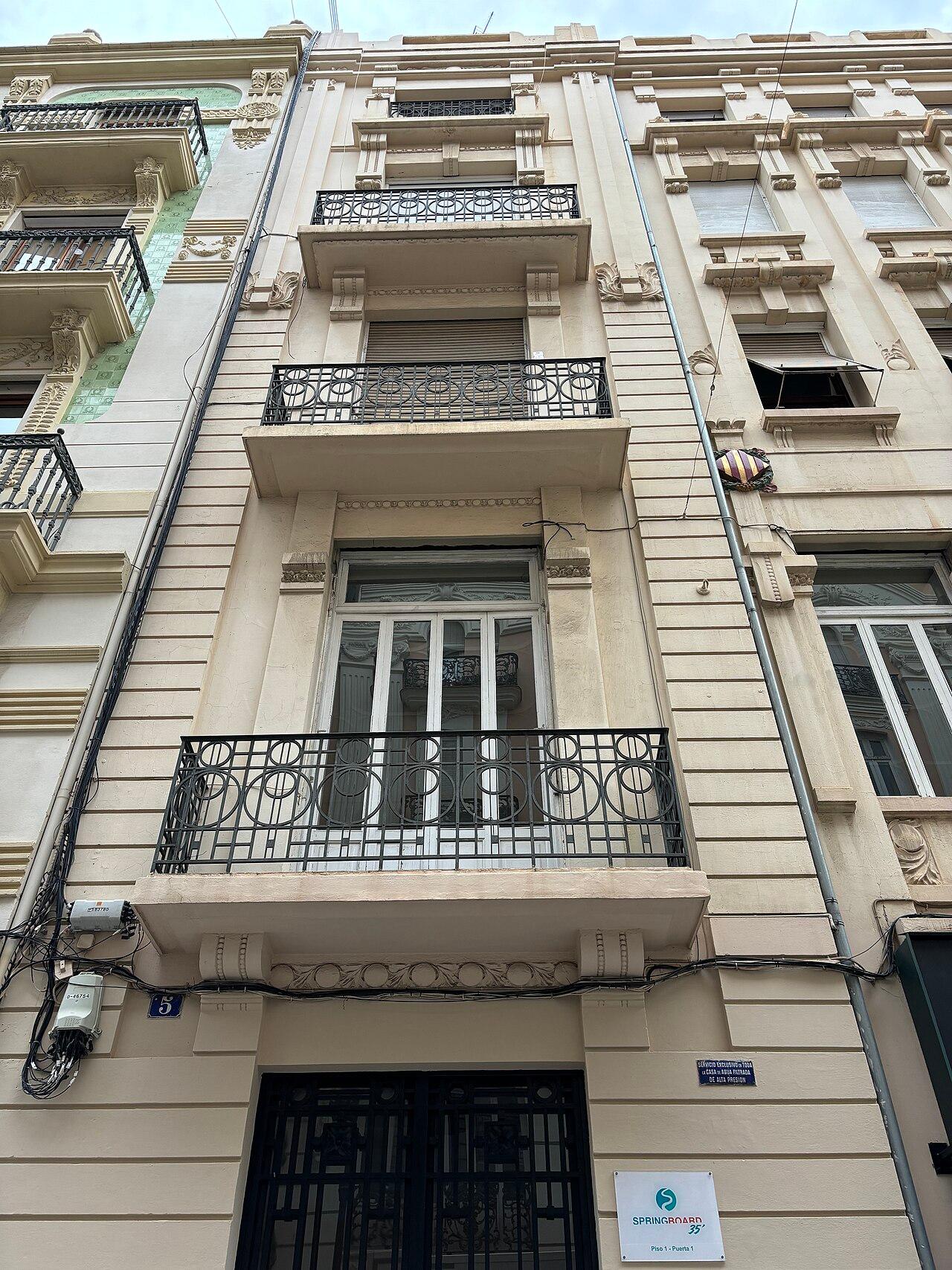
The same design returns on the door. The light wood is laid on the diagonal; three green stems rise from teardrop-shaped leaves and meet a disc pierced with small holes. Ferrer was interested in the applied arts, and he does not stop at the threshold: vestibule, stairs, and apartments follow the same vocabulary. That was rare in Valencia.
Valencia did not follow. Its bourgeoisie stuck to modernisme and the historical styles, and admitted the Secession only in the minor arts. Ferrer held posts in the administration, built little, and founded no school. The building his father commissioned is now an asset of local interest.
Photos : Joanbanjo (1, 2, 3), CC BY-SA 3.0 ; Joanbanjo (source), CC BY-SA 4.0 · Wikimedia Commons